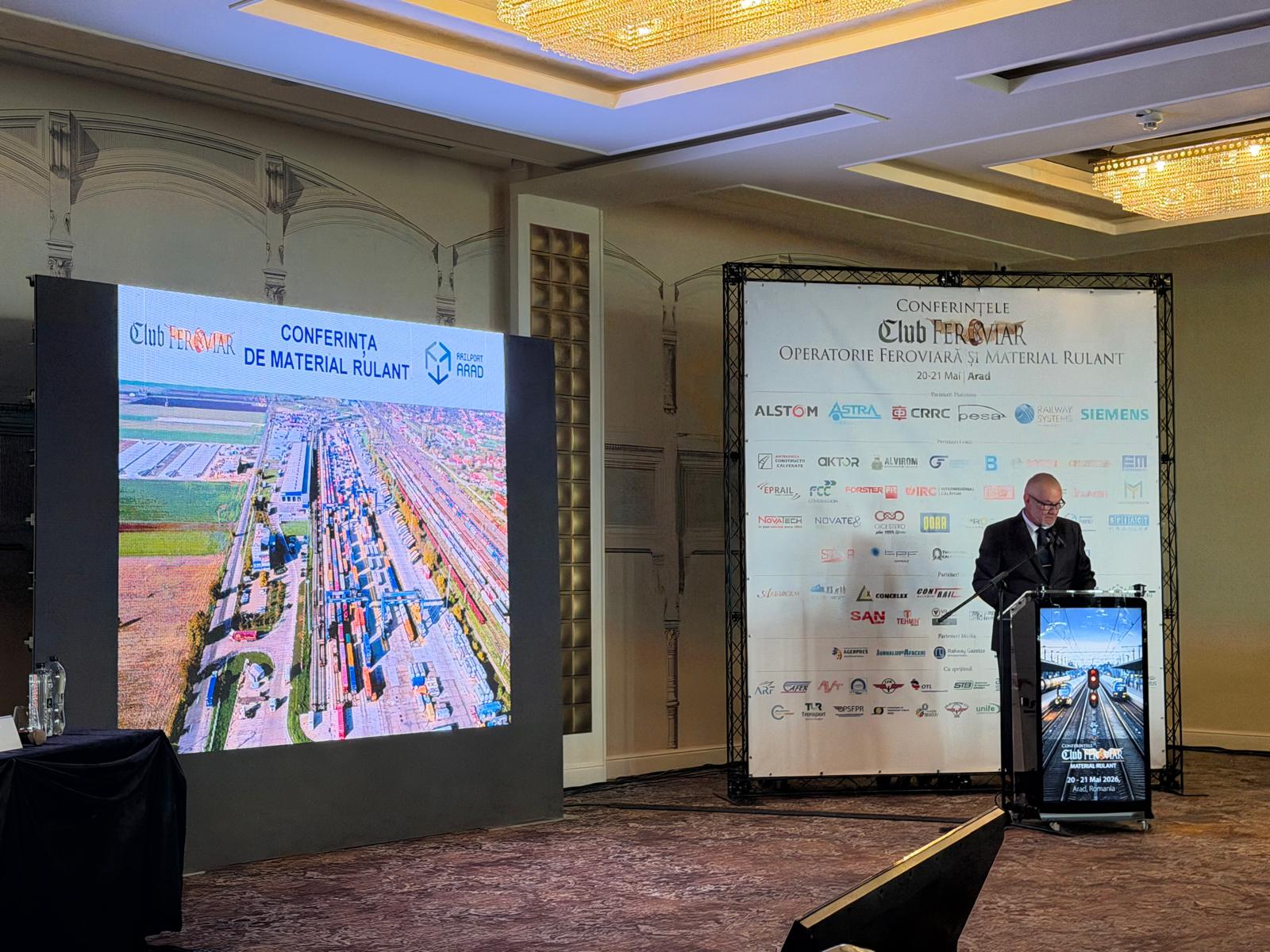
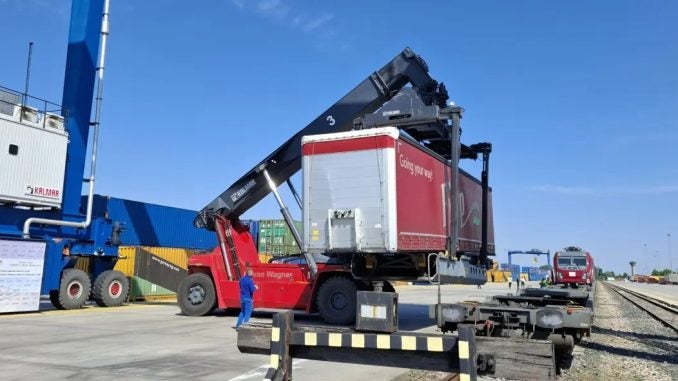
Railport Arad presented a live demonstration in Curtici of a solution that allows semi-trailers—which normally cannot be lifted by a crane—to be loaded onto railcars. The demonstration took place during the technical visit as part of the Club Feroviar conference in Arad, where István Wagner, CEO of Railport Arad, spoke about the growth of intermodal transport and the need for specialized rolling stock.
This solution is important for combined transport because most road semi-trailers in Europe are not designed for vertical lifting. Typically, the intermodal transport of semi-trailers relies on specially built units equipped with reinforced attachment points for terminal handling equipment.
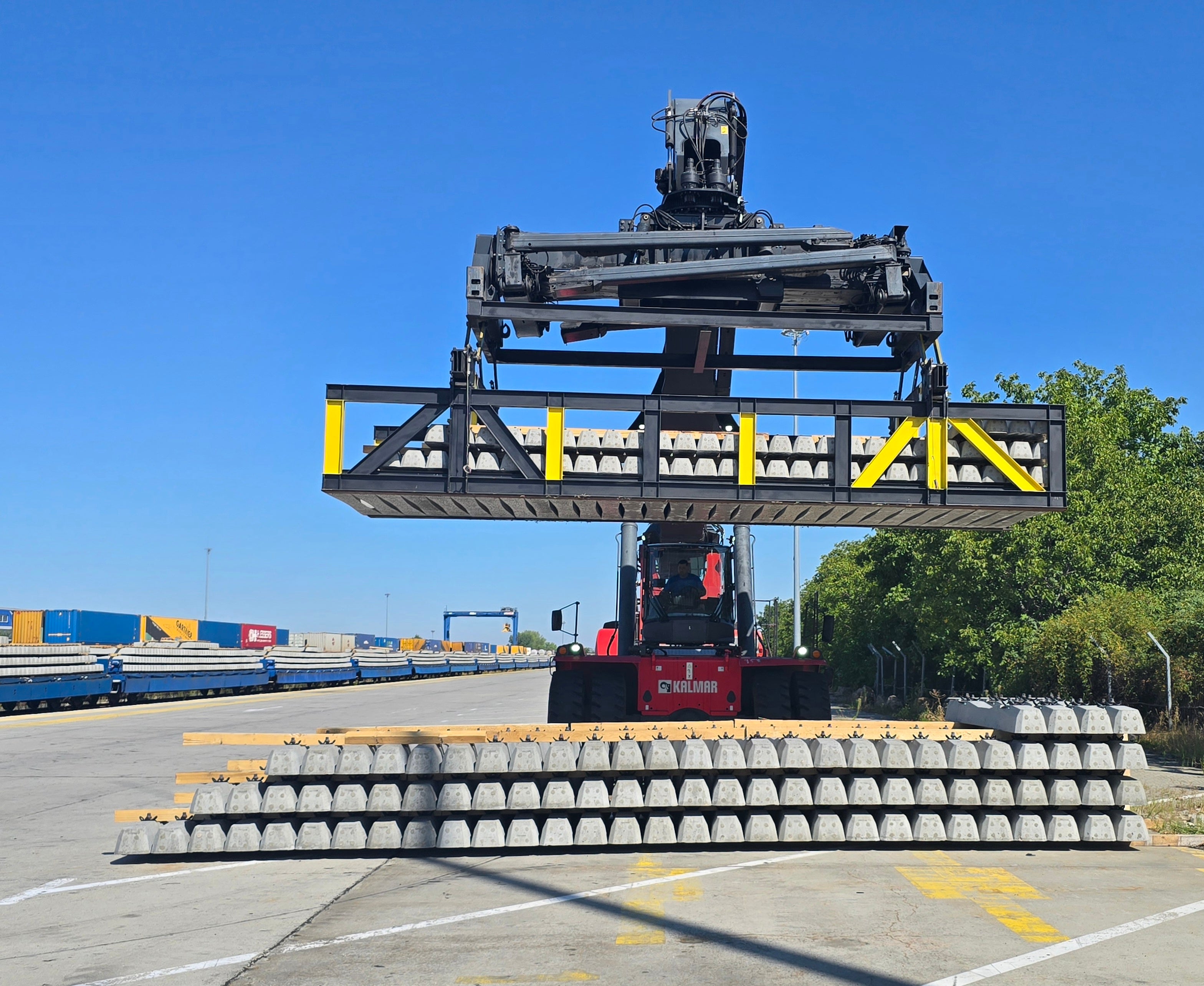
At Railport Arad, the demonstration showed how a “non-craneable” semi-trailer can be transferred onto a special railcar using an intermediate structure, described in the presentation as a “clamshell,” which fits within the railcar’s profile. Thus, semi-trailers that lack the necessary reinforcements for direct lifting can still be integrated into the intermodal rail network.
Railport Arad is preparing a new expansion
During the conference, István Wagner noted that Railport Arad, part of Curtici Cargo Center, is the largest inland intermodal terminal in Romania.
The terminal became the national leader following the expansion completed in 2016, and the company is now preparing a new phase of development.
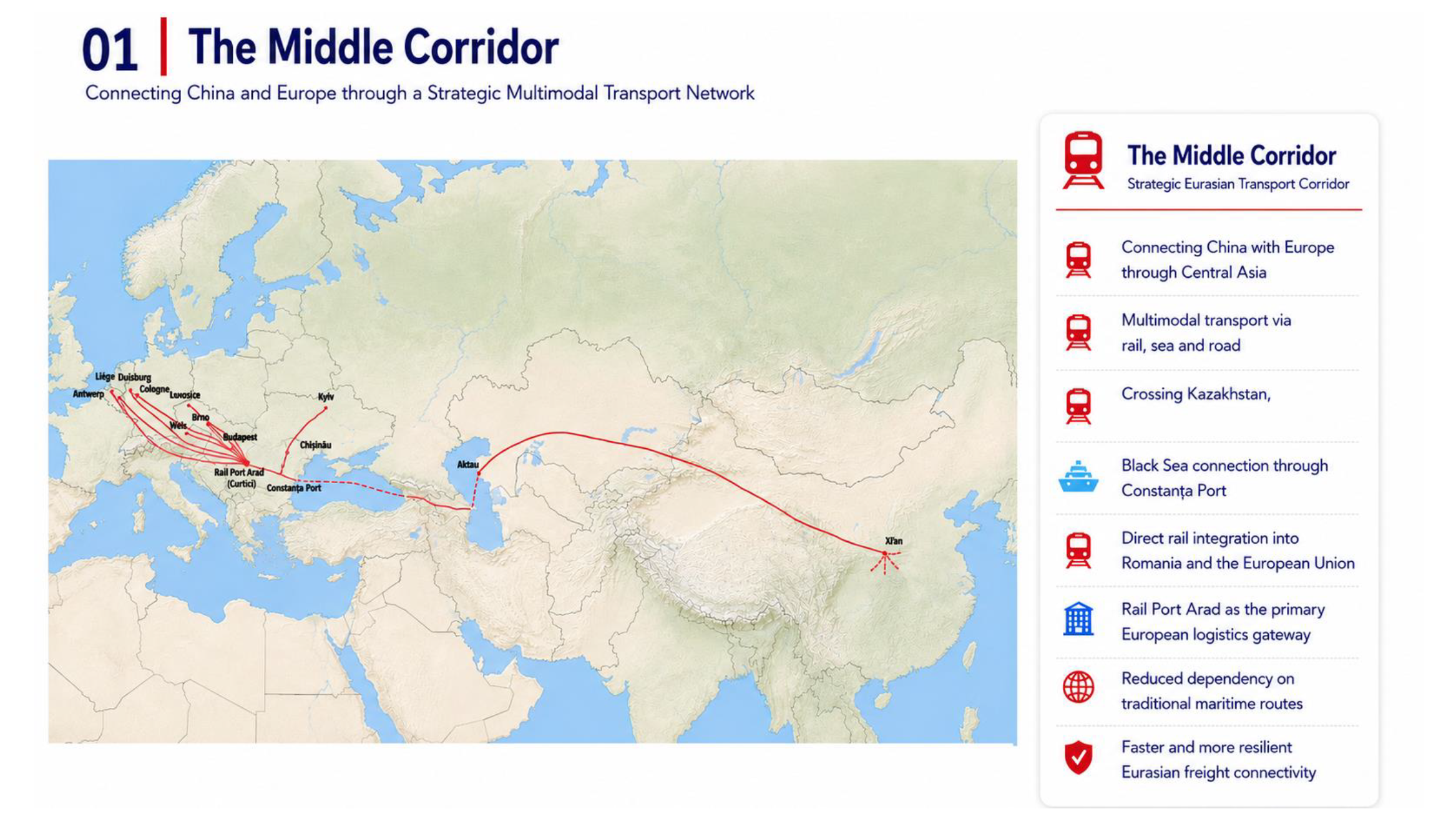
Railport Arad started with an initial investment of EUR 25 million and provides regular connections to intermodal terminals in Western Europe, including Liège, Antwerp, Duisburg, Lambach, Lovosice, and Budapest.
Terminal operations run continuously, 24/7.
The new expansion, scheduled to begin in June 2026, has a total value of EUR 9.5 million excluding VAT, with an 80% non-reimbursable component, through the 2021–2027 Transport Program. The project aims to expand the terminal onto an additional 3.5 hectares of land, adjacent to the 10.3 hectares already in use.
The works will include extending all seven rail lines within the premises to corridor parameters, namely 740 meters, expanding the technical and operational area, installing OCR gates for road and rail traffic, introducing a new terminal operating IT system, constructing a photovoltaic park for self-consumption, and building an office building.
Why Semi-Trailers Matter in Intermodal Transport
Wagner explained that intermodal transport has been called the “future” of freight transport for years, but for operators active in the field, it is already a “present reality.” Its development, however, depends on the availability of suitable rolling stock and the terminals’ capacity to handle as many types of intermodal transport units as possible.
Several types of specialized railcars arrive at Railport Arad, including container railcars and articulated railcars for semi-trailers. The presentation highlighted, among others, railcars of the Sgnss 60’, Sggmrss 90’, and Sdggmrss types, the latter being designed for transporting semi-trailers.
The difference is significant: a railcar capable of transporting semi-trailers can also carry containers, but the reverse is not true. For this reason, investing in railcars for semi-trailers can offer rail operators greater flexibility, even if it entails higher costs.
Intermodal transport has doubled in the European Union
According to data presented at the conference, the volume of freight transported intermodally in the European Union doubled between 2010 and 2025, reaching approximately 66 billion ton-kilometers last year. During the same period, road freight transport increased by approximately 10%, indicating a much faster growth rate for combined transport.
This growth was also supported by the expansion of Europe’s intermodal railcar fleet, which rose from approximately 45,000 to 70,000 railcars during the period analyzed. At the same time, the share of railcars with a load capacity of 22.5 tons per axle increased from 65% to 95%, indicating that nearly the entire European fleet has reached this standard.
Wagner also mentioned a new European framework regarding support for the acquisition of rolling stock, which could facilitate investments in railcars for small companies and startups by allowing member states to provide the necessary investment guarantees.
Western Romania, an intermodal gateway to Europe
In Romania’s case, the discussion on intermodal transport cannot be separated from the railway infrastructure. Wagner pointed out that most intermodal trains coming from Western Europe stop at terminals in the western part of the country, particularly in the Arad–Curtici area, where access to European corridor parameters already exists.
Trains up to 740 meters in length, including the locomotive, and with a gross weight of 2,000 tons can reach the Curtici station. Currently, Railport Arad is forced to break up 740-meter trains, but after the expansion project is implemented, all seven railway lines in the terminal will reach this length.
The terminal operates regular connections to several European destinations. According to the presentation, there are four train pairs per week on the Curtici–Liège route, seven on Curtici–Duisburg, three on Curtici–Lambach, two on Curtici–Antwerp, one on Curtici–Lovosice, and two on Curtici–Budapest.
A terminal ready for higher volumes
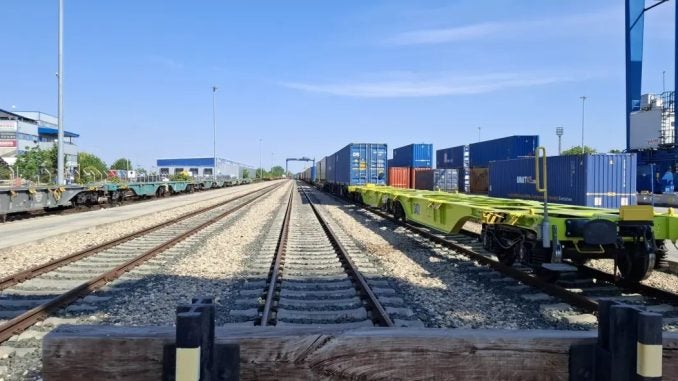
Railport Arad has four rubber-tyred gantry cranes, three reach stackers, and three terminal tractors, all manufactured by Kalmar, enabling it to handle containers, semi-trailers, flat racks, and swap bodies. The terminal has five industrial rail lines with a clear length of between 620 and 650 meters under the cranes, allowing for the parallel operation of four full trains.
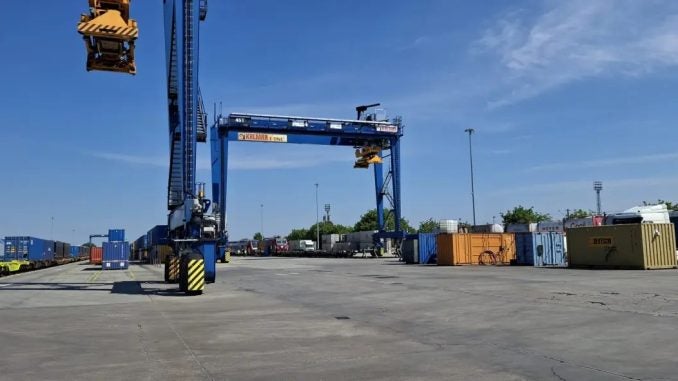
Curtici Cargo Center complements the terminal’s operations with warehousing services, rail shunting to the Curtici CFR station, agency services, freight forwarding, and first- and last-mile trucking. The complex also includes a secure parking lot for 200 trucks, driver facilities, a restaurant, and a railcar maintenance center.
Through the planned expansion and solutions such as the one demonstrated live at Curtici, Railport Arad aims to increase the flexibility of intermodal transport. The goal is clear: the more types of semi-trailers that can be transferred to rail, the larger the traffic base that can be shifted from road to rail.
Source: https://www.railwaypro.com/wp/how-can-semi-trailers-be-loaded-onto-trains/
 17 August 2026